PUE vs CHR (the "Compute Heat Rate")
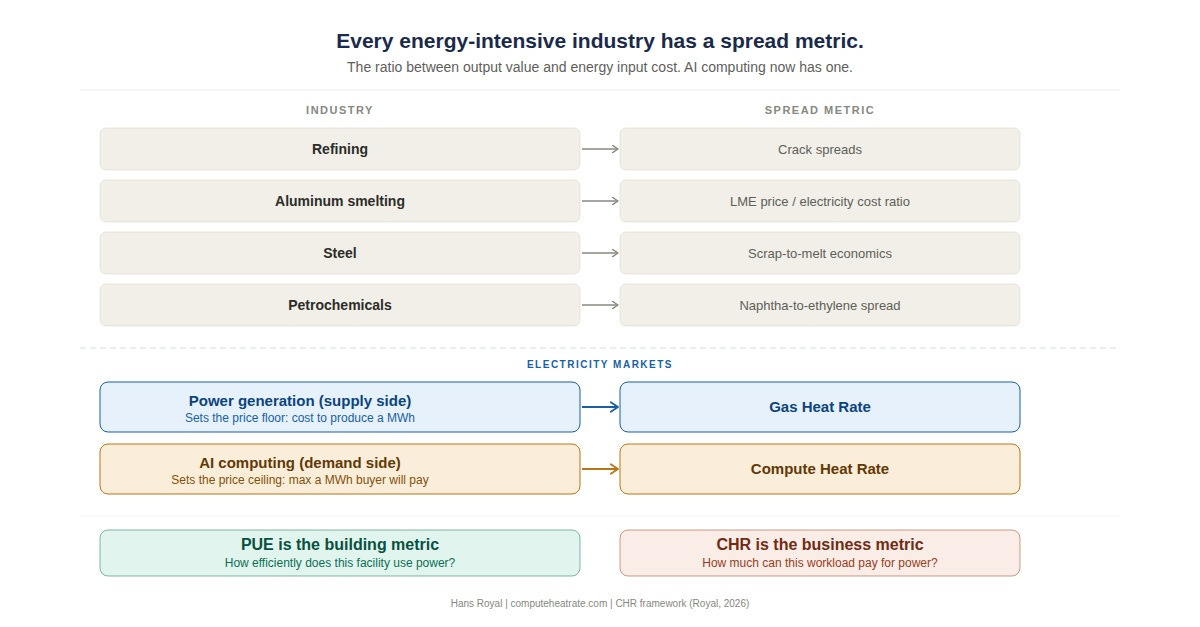
The data center industry has spent twenty years optimizing how efficiently facilities deliver power to the machines inside them. PUE, i.e. Power Usage Effectiveness (PUE), developed by The Green Grid (2007) and codified as ISO/IEC 30134-2:2016, is the standard ratio of total facility energy to IT equipment energy, and gave operators a way to benchmark and improve.
PUE answers a building question: how efficiently does this facility use power? It says nothing about what the operator can afford to pay for that power, or how the workload’s economics interact with the wholesale electricity market outside the fence line.
For two decades, this didn’t matter. Data centers were one load among many, relatively price-sensitive, modest in aggregate share. When prices spiked, operators managed around it like any large commercial consumer would.
That is not long the the energy world.
AI has introduced a demand class whose economic characteristics are categorically different from anything the grid has absorbed before. The revenue per megawatt-hour generated by frontier training clusters and high-value inference endpoints is not marginally higher than traditional computing. It is orders of magnitude higher.
Most other industries have a metric that captures this type of relationship: refining has crack spreads: the margin between crude input cost and refined product value, which tells you exactly how much a refinery can pay for feedstock. Aluminum smelting has a well-understood ratio between LME prices and electricity cost share, typically 30 to 40 percent of production cost, which sets a ceiling on tolerable power prices. Steel has scrap-to-melt economics. Petrochemicals have naphtha-to-ethylene spreads (I had to look this one up- interesting! :-) )
In every case, the metric translates the economic value of the output into a maximum tolerable cost for the energy input. It tells the grid how much this demand class can pay before it stops consuming.
AI computing needs an equivalent, which is the Compute Heat Rate™ (CHR)1.
The consequence is not abstract. It is hard distinguishing between a 100 MW facility running jobs that would curtail at $80/MWh vs a 100 MW facility running frontier model inference that would keep running above $2,000/MWh.
PUE is a building metric and CHR is a business metric: one that quantifies the demand-side price tolerance of AI workloads using the same public data that already underpins every other commodity spread in the energy economy.
This is called the Compute Heat Rate.
More soon.
Hans Royal is the originator of the Compute Heat Rate™ (CHR) framework. All views are his own and do not represent those of any employer or affiliated organization.
Royal, Hans, The Compute Heat Rate: Quantifying AI-Driven Electricity Price Tolerance
and Its Implications for Wholesale Market Repricing (February 28, 2026).
Available at SSRN: http://dx.doi.org/10.2139/ssrn.6322318
Generators are like batteries. They convert energy between forms, but do not actually create it. Natural gas, coal, solar, wind, and nuclear are the energy sources. Given the importance of natural gas as a fuel source (in front of the meter, behind the meter, and off of the grid), I can see the CHR applying to gas as well as electricity.
For example, ERCOT is expecting the Provisional Conditional Load Resource to be a vehicle that allows data centers to connect to the grid before the transmission system is built out to serve the load without any violations. So a 1,000 MW data center may have a minimum load of 100 MW, which the grid can provide today without a violation. Everything between what the grid can provide and the 1,000 MW will be provided by off-grid generation.
Add to this all of the supposed "off-grid" data center developments, and I can't help but think that natural gas prices will soon their inflexibility shortly after electricity does.