The Bubble Bet
The stock market says AI is the future. The electricity market says it's a giant bubble. They can't both be right.
Nvidia is worth $4.5 trillion. That makes it the most valuable company on Earth.
The Big Five hyperscalers plan to spend $600 to $690 billion on infrastructure in 2026 alone, roughly 75% of it directed at AI. Goldman Sachs projects cumulative hyperscaler capital expenditure of $1.15 trillion through 2027. Private equity is flooding the data center space. Capital markets have spoken: AI is real, it is scaling, and the companies building it are among the most valuable enterprises in human history.
Now look at the electricity market.
Most forward curves across PJM, ERCOT, MISO, and SPP reflect business-as-usual demand growth. Wholesale price forecasts from the major providers treat data center load as incremental, not transformational.
These two markets are looking at the same phenomenon and reaching opposite conclusions.
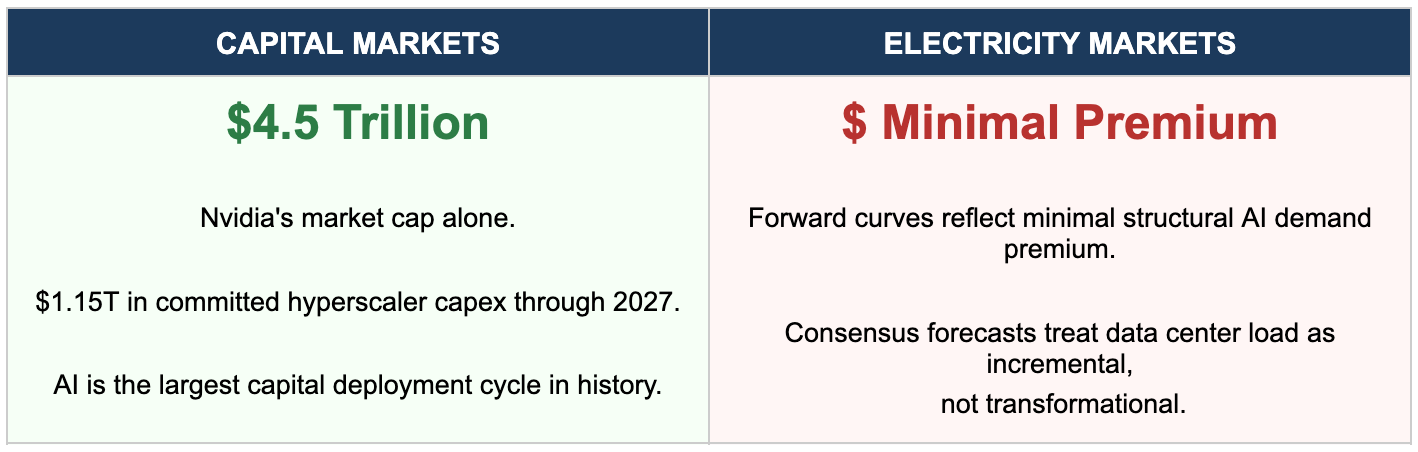
The equity market is pricing trillions in AI compute value. The electricity market is pricing zero of the demand that compute requires.
One of these markets is wrong. The question is: which one are you betting your operating margins on?
The Implicit Bet Nobody Realizes They’re Making
The energy market’s posture is not neutral. It is an active bet that AI is a bubble.
If you are an energy buyer relying on a standard forward curve, you are implicitly assuming that the tens of gigawatts of data center capacity in interconnection queues will not materialize at scale. You are assuming that the hyperscalers committing $600 billion this year are wrong. You are assuming that Nvidia’s valuation is a fantasy.
You may not think of it that way, and instead think you’re being “conservative” by assuming energy prices will be stable or go down from here. But let’s stress-test the alternative: what happens if the capital markets are right and the electricity market is wrong?
THE INSTITUTIONAL BIAS PROBLEM
Nobody ever got fired for not doing a deal. The energy director who recommends a $50/MWh PPA and watches prices stay at $40 faces uncomfortable questions. The energy director who recommends waiting and watches prices rise to $120 can blame the market.
But the financial consequences are radically different. The first scenario costs $10/MWh of opportunity cost. The second costs $70/MWh of real cost, multiplied across the full load and contract duration, measured in hundreds of millions of dollars.
Why the Gap Exists
The gap between these two markets is not irrational. It is structural. It exists because the tools the electricity market uses to forecast prices were never designed to handle what AI demand actually is.
This is the problem the Compute Heat Rate™ framework (CHR)1 was built to solve. The CHR quantifies the maximum electricity price that AI workloads can profitably sustain, derived bottom-up from GPU economics: hardware costs, utilization rates, inference throughput, and AI service revenue. The blended CHR is approximately $6,350/MWh, roughly 127 times the traditional gas heat rate.
That number is not a price forecast. It is a measurement of how much AI operators can pay before their economics break. And it means that this demand class will not curtail at any price level that existing models produce.

The Nvidia Thought Experiment
Consider what Nvidia’s valuation implies about electricity.
Nvidia’s current installed base of GPUs, plus the GPUs it will ship over the next several years, will consume an enormous and growing quantity of electricity. If you normalize Nvidia’s $4.5 trillion market capitalization to the implied electricity consumption of its hardware, you get a striking result.
Even at the CHR floor, electricity costs represent barely 1% of Nvidia’s market capitalization. The equity market is telling you, in dollars, that the value created by AI compute dwarfs the cost of the electricity it consumes. The electricity market has not received this message.
Nvidia's market cap is roughly 18 to 22 times the entire annual U.S. wholesale electricity market. The equity market and the commodity market cannot both be right.
The Window
Supply cannot rescue the status quo. A hyperscaler can build a new data center in 18 to 24 months. Energy projects take longer to build- like 2-10 years depending on the technology.
Even if supply response exceeds expectations, new generation must recover its Cost of New Entry at $80 to $130/MWh regardless of technology. The CONE is the floor, not the ceiling.
The electricity market has not yet priced this because the installed base of AI data centers has not yet crossed the critical penetration thresholds at most grid locations. This mirrors other energy market phenomena: California’s duck curve was theoretically predictable for years before solar penetration reached critical mass.
The forward curves do not say “AI is a bubble.” They say “we do not know how to price this yet.” The CHR framework provides the analytical lens to price it now.
BOTTOM LINE
The status quo is not neutral. It is an implicit, unhedged bet that AI is a bubble. Every quarter of inaction compounds the exposure. The Compute Heat Rate framework makes this invisible risk visible, quantifiable, and actionable.
Hans Royal is the originator of the Compute Heat Rate™ (CHR) framework. All views are his own and do not represent those of any employer or affiliated organization.
Royal, Hans, The Compute Heat Rate: Quantifying AI-Driven Electricity Price Tolerance
and Its Implications for Wholesale Market Repricing (February 28, 2026).
Available at SSRN: http://dx.doi.org/10.2139/ssrn.6322318